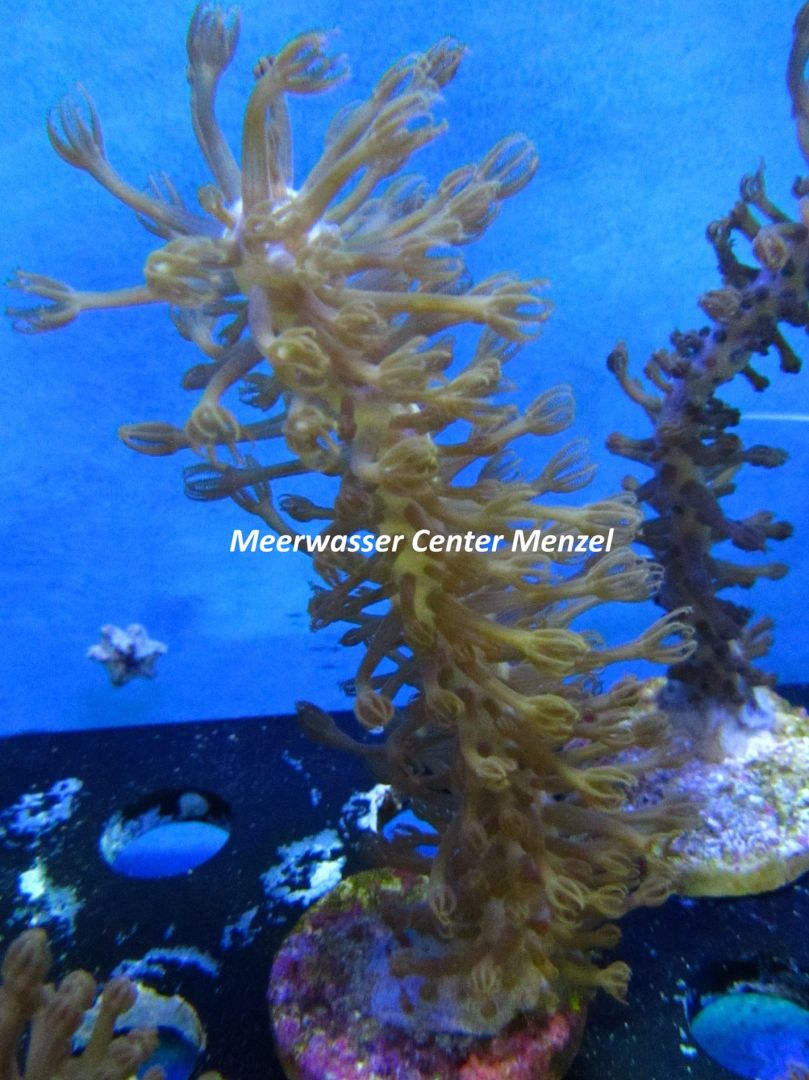
Species Profile: Rumphella sp.
Scientific name: Rumphella sp.
Common name: Gorgonian / Sea Fan
Family: Melithaeidae
Class: Anthozoa (Cnidarians)
Order: Alcyonacea (Soft Corals)
Distribution: Indo-Pacific
Habitat: Coral reefs, rocky reefs and areas with strong water movement
Diet: Plankton and fine organic particles
Lifestyle: Colonial, sessile and suspension-feeding
Appearance
Rumphella sp. belongs to the gorgonians and forms upright, branching colonies. The branches can vary considerably in their shape and degree of branching depending on the species and environmental conditions.
The characteristic skeleton consists of a flexible, horn-like central axis that provides structural support to the colony. The surface is covered with numerous small polyps which, when fully extended, give the colony a delicate and bushy appearance.
Depending on the species, coloration can range from reddish and orange tones to yellowish or brownish shades.
Habitat and Distribution
Species of the genus Rumphella are distributed throughout the tropical Indo-Pacific. They are mainly found attached to hard substrates on coral reefs and rocky reef areas.
The colonies often prefer locations with moderate to strong water movement. Water currents transport plankton and organic particles towards the polyps and therefore support their feeding.
Behavior and Lifestyle
Rumphella sp. is a sessile coral and remains permanently attached to its substrate. Its individual polyps can extend and retract their tentacles.
The colony grows by producing new branches and polyps. Its branching structure can also provide shelter and habitat for small crustaceans and other reef organisms.
Diet
Rumphella sp. primarily feeds on plankton and fine organic particles suspended in the water column.
The polyps filter food particles from the surrounding water. Good, turbulent water movement is therefore particularly important for feeding and colony growth.
Keeping in a Marine Aquarium
Keeping Rumphella sp. can be challenging. It should be maintained in a well-established marine aquarium with stable water parameters and sufficient water movement.
A location with good, turbulent flow is ideal. The current should regularly deliver fresh, oxygen-rich water and food particles to the polyps without causing excessive mechanical stress to the colony.
Because Rumphella sp. grows in a branching form and can reach a considerable size depending on the species, sufficient space should be provided for future growth. Adequate distance from other corals is also recommended to minimize competition and unwanted contact.
Special Features
One of the most distinctive features of Rumphella sp. is its characteristic branching growth form. Its flexible skeletal structure allows the colony to move slightly within the surrounding water currents.
Its striking growth form and potentially intense coloration make Rumphella sp. an attractive feature in a suitable reef aquarium. At the same time, its plankton-based diet means that it generally requires a more consistent supply of fine food particles than many easier-to-keep corals.
* This text was edited using AI and has been reviewed by us for accuracy
 Secure payment
 Live arrival guaranteed
 Various exclusive articles
 Overnight shipping service Europe-wide