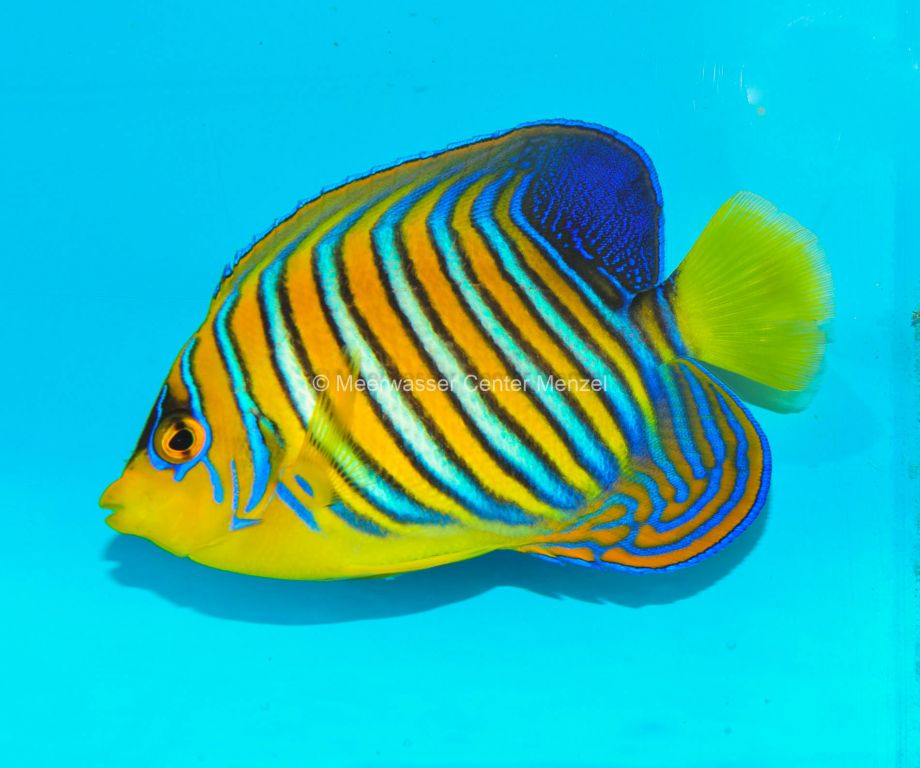

Pygoplites diacanthus – Yellow Belly Variant
Common name: Regal Angelfish / Royal Angelfish
Scientific name: Pygoplites diacanthus
Color variant: Yellow Belly
Family: Angelfish (Pomacanthidae)
Origin: Indian Ocean and Red Sea
Habitat: Coral reefs, lagoons, reef slopes, and caves
Adult size: approx. 20–25 cm
Life expectancy: up to approx. 15 years or longer with optimal care
Difficulty: Advanced
Temperature: approx. 24–27 °C
pH: approx. 8.0–8.4
Salinity: approx. 1.023–1.026 SG
Diet: Omnivorous, with a strong preference for animal-based foods
Behavior: Peaceful, shy, site-oriented, and territorial
Recommended tank size: From approx. 800–1,000 liters
Keeping: Best kept singly or as a pair in a sufficiently large aquarium
Special Features
The Regal Angelfish (Pygoplites diacanthus) is one of the most spectacularly colored angelfish and is a true centerpiece fish for large marine aquariums.
The Yellow Belly variant, also commonly known as the “Yellow Belly,” is characterized by an especially intense yellow coloration on the breast and belly area. This color form is particularly associated with specimens from the Indian Ocean and the Red Sea.
The body features striking vertical bands of bright yellow, white, and blue-black. The dorsal and anal fins also display intense blue markings. Juveniles have a distinctive eyespot on the dorsal fin, which changes as the fish matures.
Care
The Regal Angelfish is considered one of the more challenging marine fish to keep. Acclimation and feeding can be particularly demanding. In the wild, the species feeds on sponges, tunicates, and other small invertebrate food sources and may be reluctant to accept substitute foods.
A large, mature aquarium with excellent and stable water quality, plenty of reef structures, caves, and sufficient open swimming space is therefore essential.
Whenever possible, specimens should be purchased from a reliable source and should already be actively feeding. Captive-bred fish that have been conditioned to accept prepared foods generally offer significantly better prospects for successful long-term aquarium care.
Social Behavior
Pygoplites diacanthus is generally a peaceful and rather shy angelfish. In the wild, it is usually found singly or in pairs and can occasionally occur in small groups.
In an aquarium, it may become territorial toward other Regal Angelfish or similarly colored angelfish. Keeping a single specimen is therefore usually the easiest option.
Due to its relatively shy nature, it should not be housed with highly aggressive or excessively active tank mates.
Diet
A varied and regular feeding regime is particularly important for this species.
In nature, the Regal Angelfish feeds on sponges, tunicates, and other small invertebrate food sources.
Suitable foods include:
- High-quality frozen foods
- Mysis and Artemia
- Krill
- Sponge-based foods
- Zooplankton
- High-quality marine pellets
- Nori and other suitable algae-based foods
- Specialized angelfish food mixes
Ideally, the fish should be fed several small meals throughout the day. A varied diet helps maintain its intense coloration, body condition, and long-term health.
Reef Compatibility
The Regal Angelfish is not considered completely reef-safe. As with many larger angelfish, it may nip at corals, sponges, clams, and other sessile invertebrates.
Aquarists keeping this species in a reef aquarium should therefore be prepared for the possibility of some feeding damage to corals and other invertebrates.
Yellow Belly
The Yellow Belly variant is particularly valued for its intense golden-yellow coloration. It is not a separate species, but rather a geographically associated color form within Pygoplites diacanthus. In the aquarium trade, it is commonly referred to as the Yellow Belly Regal Angelfish.
This exceptionally bright yellow coloration makes the Yellow Belly variant especially sought after by experienced marine aquarists.
* This text was edited using AI and has been reviewed by us for accuracy
 Secure payment
 Live arrival guaranteed
 Various exclusive articles
 Overnight shipping service Europe-wide